World
World
British, Russian statements highlight divisions ahead of G20 ministers’ meeting
G20 foreign ministers’ meeting is happening against the backdrop of divisions within the grouping of the world’s largest economies over the Ukraine crisis
Two separate statements issued by Britain and Russia have highlighted the challenges confronting India as it hosts a meeting of the G20 foreign ministers against the backdrop of divisions within the grouping of the world’s largest economies over the Ukraine crisis. Hours before UK foreign secretary James Cleverly’s arrival in New Delhi, Britain’s foreign office said he will “continue to call out Russian aggression in Ukraine at a foreign ministers meeting for India’s G20 Presidency and urge partners old and new to work together to tackle the most urgent global challenges”. Cleverly was quoted as describing India as a “hugely important partner to the UK”, and the British statement emphasised that even if the war in Ukraine “were to end today, the effects of the exacerbated food insecurity would still run into 2027”.
And as Russian foreign minister Sergey Lavrov landed in India late on Tuesday night, the foreign ministry in Moscow issued a strongly worded statement that sought to blame the US and its allies for the Ukraine crisis and said their actions had “put the world on the brink of a disaster, provoked a rollback in socio-economic development and seriously aggravated the situation of the poorest countries”.
Without directly referring to what Russia describes as a “special military operation” in Ukraine, the statement contended that the world is “suffering from the cynical revelry of illegal sanctions, the artificial breakup of cross-border supply chains, the imposition of notorious price ceilings and, in effect, from attempts to steal natural resources”. The remarks were a tacit reference to Western sanctions imposed on Russia for the invasion of Ukraine and the recent price cap imposed on Russian oil by the G7.
The two statements effectively captured the divisions India has had to navigate for its G20 presidency and which resulted in the G20 finance ministers meeting in Bengaluru during February 24-25 ending without a joint communique. China and Russia had opposed the inclusion of two paras on the Ukraine war in the draft communique on the grounds that the G20 is a forum for handling economic issues and should not take up geo-political matters.
India was forced to issue a chair’s summary at the conclusion of the G20 finance ministers meeting that retained language from the leaders’ declaration at the last G20 Summit in Bali about most members of the grouping strongly condemning the war in Ukraine while others offered alternate views and different assessments of the situation and sanctions.
Ahead of the G20 foreign ministers meeting, the Indian side has said it will push the consensus reached at the G20 Summit in Indonesia in order to find a way out of the impasse. However, the rigid positions taken by Russia and China on one side and the G7 on the other have heightened concerns that the G20 foreign ministers meeting during March 1-2 too could end without any joint statement.
People familiar with the matter said India’s “considered and balanced” position had contributed to forging the leaders’ declaration at the summit in Bali. “Our endeavour was to reflect the Bali consensus in the G20 finance ministers’ meeting. This was expressed in the chair’s summary and outcome document. The Indian side will continue to push the Bali consensus because this is something all the members had agreed on,” one of the people said.
Diplomatic circles are closely watching a networking reception and dinner to be hosted on March 1 by external affairs minister S Jaishankar for his G20 counterparts and nine guest countries, as it will set the stage for discussions during two sessions the following day. The G7 foreign ministers had boycotted a similar dinner in Indonesia in July 2022 over Russian foreign minister Sergey Lavrov’s presence.
While most of the G20 foreign ministers are expected to be at the dinner on Wednesday night, the foreign ministers of France, Germany and the US were not expected to arrive in time for the event, the people said.
The first session for the G20 foreign ministers meeting on March 2 will focus on strengthening multilateralism and the need for reforms of multilateral bodies such as the UN, food and energy security, and development cooperation. The second session will be devoted to counter-terrorism and emerging threats, global skill mapping, and humanitarian assistance and disaster relief.
External affairs minister S Jaishankar is set to hold a series of bilateral meetings with his counterparts from G20 states and the guest countries, including Lavrov, US secretary of state Antony Blinken and Chinese foreign minister Qin Gang, who is making his first visit to India since his appointment last year.
Biden’s Ukraine visit upstages Putin and leaves Moscow’s military pundits raging
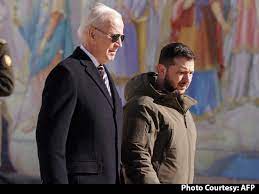
President Joe Biden’s surprise visit to Ukraine sparked anger and embarrassment among many of Russia’s hawkish military pundits on Monday, increasing pressure on Vladimir Putin as the Russian leader prepares to justify his stuttering invasion in a national address.
Biden’s historic visit came days before the one-year anniversary of Russia’s full-scale invasion of Ukraine, providing a symbolic boost to Kyiv at a crucial juncture in the conflict.
But the visit caused fury in Russian pro-military and ultranationalist circles, as it upstages Putin on the eve of a major address in which the Russian president is expected to tout the supposed achievements of what he euphemistically calls a “special military operation.”
“Biden in [Kyiv]. Demonstrative humiliation of Russia,” Russian journalist Sergey Mardan wrote in a snarky response on his Telegram channel. “Tales of miraculous hypersonics may be left for children. Just like spells about the holy war we are waging with the entire West.”
“I guess there are lunch breaks in a holy war,” he said.
Russian army veteran and former Federal Security Service (FSB) officer Igor Girkin meanwhile suggested that Biden could have visited the frontlines in eastern Ukraine and escaped unharmed.
“Wouldn’t be surprised if the grandfather (he is not good for anything but simple provocations anyway) is brought to Bakhmut as well… AND NOTHING WILL HAPPEN TO HIM,” Girkin said.
Girkin is among a number of hardline military bloggers – some of whom have hundreds of thousands of followers and provide analysis of the conflict for large swaths of the Russian population – who have repeatedly criticized what they consider a “soft” approach on the battlefield by Putin’s generals.
For many, the secure and skillfully executed visit of a US President was another symbol of a faltering campaign.
A Telegram account managed by Russian army and naval servicemembers, Zapiski michmana Ptichkina, noted ironically that Biden had reached Kyiv before Russian President Vladimir Putin. “Almost a year after the beginning of the Special military operation, we are waiting in the Russian city of [Kyiv] for the president of the Russian Federation, but not for the [President of the] United States,” it said.
Biden’s visit was an unprecedented journey by a US leader into an active warzone where the US did not have a large military presence.
A few hours before he departed, the United States informed Russia of the plans to visit the Ukrainian capital for “deconfliction purposes,” according to Biden’s national security adviser Jake Sullivan.
“Biden, having received security guarantees in advance, finally went to Kyiv,” Medvedev said in a statement on Telegram. “And of course, there were mutual incantations about the victory that would come with new weapons and a courageous people. And here it is important to note that the West already delivers weapons and money to Kyiv quite regularly. In huge quantities, allowing the military-industrial complex of NATO countries to earn money and steal weapons to sell to terrorists around the world.”
Medvedev, who currently serves as deputy head of Russia’s Security Council, is known for making belligerent pronouncements in an apparent bid to shore up his nationalist credentials.
The debate over Biden’s visit will be unwelcome to Putin, who will on Tuesday make a major speech to the Federal Assembly in which he will discuss the ongoing invasion.
Participants of what Russia refers to as its “special military operation” will be in attendance but foreign guests or representatives will not be invited, the Kremlin’s spokesperson told reporters Monday.
Putin is expected to launch a renewed offensive in Ukraine in the coming weeks, more than one year after he began Europe’s biggest land war since World War II with a failed assault on Kyiv and central Ukraine.
Japan promises to ‘lead the world’ in fighting Russian aggression with $5.5 billion in Ukraine aid
Japan pledged $5.5 billion in humanitarian aid to Ukraine on Monday, nearly quadrupling the amount of money Tokyo has promised to Kyiv since Russia invaded its neighbor nearly a year ago.
“Japan is in a position to lead the world’s efforts to support Ukraine in its fight against Russian aggression and to uphold a free and open international order based on the rule of law,” Prime Minister Fumio Kishida said Monday.
Tokyo had previously pledged to send Kyiv $600 million in financial assistance and $700 million worth of humanitarian aid including medical supplies and food assistance. It also joined Western allies in imposing strict sanctions on Russia over its invasion. Last summer, Kishida said in a speech that Russia’s invasion gave warning that “Ukraine today may be East Asia tomorrow” – and he echoed that language Monday. “Russia’s aggression against Ukraine is not just a European matter, but a challenge to the rules and principles of the entire international community,” he said. He added that Japan faces its “most severe” security environment since World War II, citing North Korea’s growing nuclear missile program and “attempts to unilaterally change the status quo by force in the East and South China Seas.”
Kishida did not name specifics, but Tokyo has seen itself increasingly at odds with Beijing over islands claimed by both Japan and China in the East China Sea. Meanwhile, Kishida and other Japanese officials have previously said that peace across the Taiwan Strait is of extreme importance to Japan’s security.
Late last year, Kishida announced a large increase in Japanese military spending and Tokyo’s intention to acquire long-range weapons to counter threats to Japan’s security. Kishida also announced on Monday that he will host an online summit of G7 leaders with Ukrainian President Volodymyr Zelensky on Friday, the first anniversary of Moscow’s invasion and ahead of the annual G7 summit in Hiroshima in May.
The Japanese leader said Hiroshima was an appropriate venue for the summit as the city was the site of an atomic bombing during World War II and Moscow’s invasion of Ukraine is raising new nuclear fears.
“Due to Russia’s actions, the world now faces a real threat from nuclear weapons,” Kishida said. “It is important to convey the reality of the atomic bombings to the world, including the G7 leaders, as the starting point for all efforts toward nuclear disarmament.”
The Taliban government in Afghanistan confirmed the killing of top ISKP leaders Qari Fateh and Abu Usman Al-Kashmiri in a counter-terror op in Kabul.
The Taliban government in Afghanistan said its security forces killed two key Islamic State commanders during a counter-terrorism raid in capital Kabul a few days ago. One of the slain terrorists was Qari Fateh, touted as the intelligence chief and a former minister of war of the Islamic State-Khorasan Province (ISKP), said Taliban spokesperson Zabihullah Mujahid. The ISKP is an Afghan affiliate of Islamic State and a key Taliban adversary.
Biden’s Ukraine visit upstages Putin and leaves Moscow’s military pundits raging
President Joe Biden’s surprise visit to Ukraine sparked anger and embarrassment among many of Russia’s hawkish military pundits on Monday, increasing pressure on Vladimir Putin as the Russian leader prepares to justify his stuttering invasion in a national address.
Biden’s historic visit came days before the one-year anniversary of Russia’s full-scale invasion of Ukraine, providing a symbolic boost to Kyiv at a crucial juncture in the conflict.
But the visit caused fury in Russian pro-military and ultranationalist circles, as it upstages Putin on the eve of a major address in which the Russian president is expected to tout the supposed achievements of what he euphemistically calls a “special military operation.”
“Biden in [Kyiv]. Demonstrative humiliation of Russia,” Russian journalist Sergey Mardan wrote in a snarky response on his Telegram channel. “Tales of miraculous hypersonics may be left for children. Just like spells about the holy war we are waging with the entire West.”
“I guess there are lunch breaks in a holy war,” he said.
Russian army veteran and former Federal Security Service (FSB) officer Igor Girkin meanwhile suggested that Biden could have visited the frontlines in eastern Ukraine and escaped unharmed.
“Wouldn’t be surprised if the grandfather (he is not good for anything but simple provocations anyway) is brought to Bakhmut as well… AND NOTHING WILL HAPPEN TO HIM,” Girkin said.
Girkin is among a number of hardline military bloggers – some of whom have hundreds of thousands of followers and provide analysis of the conflict for large swaths of the Russian population – who have repeatedly criticized what they consider a “soft” approach on the battlefield by Putin’s generals.
For many, the secure and skillfully executed visit of a US President was another symbol of a faltering campaign.
A Telegram account managed by Russian army and naval servicemembers, Zapiski michmana Ptichkina, noted ironically that Biden had reached Kyiv before Russian President Vladimir Putin. “Almost a year after the beginning of the Special military operation, we are waiting in the Russian city of [Kyiv] for the president of the Russian Federation, but not for the [President of the] United States,” it said.
Biden’s visit was an unprecedented journey by a US leader into an active warzone where the US did not have a large military presence.
A few hours before he departed, the United States informed Russia of the plans to visit the Ukrainian capital for “deconfliction purposes,” according to Biden’s national security adviser Jake Sullivan.
“Biden, having received security guarantees in advance, finally went to Kyiv,” Medvedev said in a statement on Telegram. “And of course, there were mutual incantations about the victory that would come with new weapons and a courageous people. And here it is important to note that the West already delivers weapons and money to Kyiv quite regularly. In huge quantities, allowing the military-industrial complex of NATO countries to earn money and steal weapons to sell to terrorists around the world.”
Medvedev, who currently serves as deputy head of Russia’s Security Council, is known for making belligerent pronouncements in an apparent bid to shore up his nationalist credentials.
The debate over Biden’s visit will be unwelcome to Putin, who will on Tuesday make a major speech to the Federal Assembly in which he will discuss the ongoing invasion.
Participants of what Russia refers to as its “special military operation” will be in attendance but foreign guests or representatives will not be invited, the Kremlin’s spokesperson told reporters Monday.
Putin is expected to launch a renewed offensive in Ukraine in the coming weeks, more than one year after he began Europe’s biggest land war since World War II with a failed assault on Kyiv and central Ukraine.